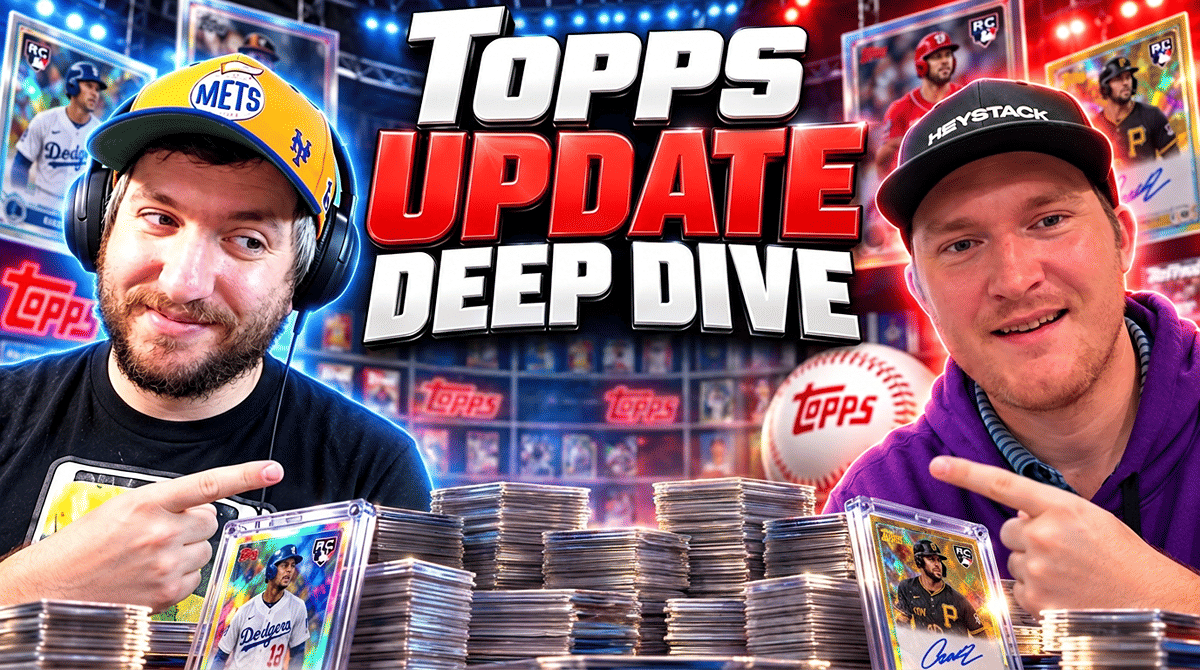
Topps Update Baseball Deep Dive: What to Know Before You Rip
Topps Update Baseball is the final chapter in the flagship trilogy, and it always brings a different kind of excitement than Series 1 or Series 2. In this breakdown, you’ll learn what’s actually in the product, which rookies matter, how the inserts and parallels stack up, and which chase cards are worth paying attention to if you’re buying, ripping, or breaking boxes. [INTERNAL LINK: Related post on Topps Series 1 vs Series 2 vs Update]Update is also a little unusual this year. Some of the biggest names you might expect are missing, a few rookies already showed up in earlier flagship releases, and the checklist feels more strategic than usual. That makes knowing the product important before you spend money on it.
What Topps Update Baseball Is and Why It Matters
Topps Update Baseball is the third and final flagship release of the year, following Topps Series 1 and Topps Series 2. It serves as a kind of wrap-up set for the season, adding rookies, traded players, fresh inserts, and chase cards to the flagship lineup.If you’ve opened flagship before, you already know the basic formula. There’s a large base set, a pile of parallels, a mix of inserts, and a handful of big hits that can make a box feel huge. Update keeps that structure, but it usually feels a little more hit-forward because the print run is lower than Series 1. [CHART/GRAPH: Compare Series 1 vs Series 2 vs Update print run]For 2026 Update, the hobby format is a 20-pack box with 12 cards per pack and one auto or relic per hobby box. Topps also has jumbo boxes, retail versions, and the usual chase structure that keeps collectors looking for the right configuration. [IMAGE: Hobby, jumbo, and retail box lineup]The key thing to understand is that Update is not just “more cards.” It’s where Topps decides which rookies get included, which players get held back, and which names get pushed into next year’s products. That makes the checklist part of the story, not just the hits.[INTERNAL LINK: Guide to understanding flagship baseball card releases]
The Rookie Checklist Is Good - But Not What You’d Expect
The rookie class in Update is strong, but it’s not the kind of release where every late-season debut you hoped for shows up. Topps appears to be leaving some players out on purpose, likely to keep future releases stronger and avoid overcrowding the current year.That means some guys who debuted early enough to feel like they “should” be in Update are missing. AJ Ewing, Spencer Jones, and Gage Jump were all mentioned as notable omissions. If you’re the kind of collector who likes chasing first flagship rookies, that matters.At the same time, the names that do appear are still very appealing. Some of the major rookies include:
Connor Griffin
Carson Benge
Kevin McGonagall
JJ Weatherholt
Travis Bazana
Justin Crawford
Joe Mack
These are the names most likely to drive the product early, especially if you’re chasing autos, short prints, or color parallels.The interesting wrinkle this year is that a lot of top rookies already showed up in earlier releases. That means Update is less about finding a player’s true first flagship appearance and more about finding the best version of a player already in the pipeline. For collectors, that changes the way you value the set. [INTERNAL LINK: Rookie card checklist strategy for collectors][IMAGE: Collage of the top rookie names from the checklist]
[ALT TEXT: Topps Update Baseball rookie checklist featuring Connor Griffin, Carson Benge, Kevin McGonagall, JJ Weatherholt, Travis Bazana, and Justin Crawford]Rookie Debuts, Base Rookies, and the One-Per-Player RuleUpdate includes rookie debut cards, which are alternate images with a debut date on the back. Some collectors love them because they preserve important early-year debuts that might not otherwise get a true rookie card. Others find them confusing because the image differences can make them look like variations at first glance.That confusion is real. If you rip a lot of flagship, these cards can absolutely trick your eyes before you realize they’re just rookie debut versions. Still, they’re better than leaving those players out entirely.There’s also a useful rule to remember: once a rookie appears on one of these flagship rookie checklists, they usually don’t repeat later in the same cycle. So if a player appeared in Series 1, you should not assume they’ll show up again in Update. That matters a lot when you’re buying into breaks or targeting a specific player.
The Chase Cards Are What Make Update Fun
This is where Update gets interesting. Topps has packed the set with a lot of different chase lanes, and that’s part of what makes flagship so addictive. You’re not just hunting one big card - you’re hunting several different layers of scarcity.Some of the most notable chase categories include:
1952 rookie variations
Golden Mirror variations
All Aces
All Kings
Home Field cards
Heavy Lumber
True Photo variations
Rookie clear variations
Vintage stock variations
That’s a lot, but the short version is this: there are multiple paths to a big pull, and not all of them are created equal.The 1952 Rookies and True Photo VariationsThe 1952 rookie variations remain one of the most desirable chases in flagship. They’re hard to hit, visually appealing, and especially strong when the player is a major name. In this checklist, names like Connor Griffin, Carson Benge, Kevin McGonagall, JJ Weatherholt, and Justin Crawford stand out. [IMAGE: 1952 rookie variation example card]True photo variations are another collector favorite. These are the clean, stripped-down versions with no nameplate or extra design elements - just the photo. They’re easy to mistake for an error card if you don’t know what you’re looking at, but they’re intentional and often sell very well.[ALT TEXT: Topps Update true photo variation card with clean photo-only design]Golden Mirrors and Other SSP-Style InsertsGolden Mirror variations continue to be one of the best things Topps does in flagship. They’re visually distinctive, tough to find, and generally respected across the hobby. The rookie versions are especially strong, and the legend versions can be just as exciting.One big lesson here: don’t ignore the back of the card. Golden Mirror cards are identified by their finish and design details, and they can be easy to miss if you’re sorting quickly.Then there’s All Aces and All Kings. All Kings, in particular, looks stronger this year than All Aces. The All Kings checklist includes names like Connor Griffin, JJ Weatherholt, Kevin McGonagall, Carson Benge, Travis Bazana, Jose Ramirez, Kyle Schwarber, Corbin Carroll, Lou Gehrig, Sam Usual, and Ted Williams. That’s a very strong mix of rookies, stars, and legends. [INTERNAL LINK: Best SSP baseball cards to chase in 2026]All Aces is a little softer by comparison. It still has strong names like Nolan Ryan, Justin Verlander, Chris Sale, Roger Clemens, and a few rookie pitchers, but it doesn’t feel as loaded as All Kings.Home Field cards are the flagship answer to downtown-style art cards, and they remain popular. Heavy Lumber is similar in rarity and appeal, but it doesn’t have the same chromified momentum that Home Field has gained in recent years. If you’re choosing between the two for a personal collection, it really comes down to design preference. [IMAGE: Side-by-side comparison of Home Field and Heavy Lumber cards]
The Inserts, Relics, and Autos That Actually Matter
Not every insert in Update is worth obsessing over, but a few sections really stand out.The Best Inserts Worth WatchingThe 1991 Topps Baseball design returns in multiple forms, including standard inserts, Chrome silver pack cards, and autos. The design itself is popular because it’s clean, nostalgic, and easy to recognize. The Chrome silver pack versions are especially appealing because they can turn insert cards into something much more valuable when color or autograph parallels show up.Black Gold is another strong insert. It has a recognizable design and a nice mix of rookies, stars, and legends. It’s the kind of insert set that feels fun to complete without being meaningless filler.The Matte Sketch Art cards are also worth noting. They’re visually bold, a little unusual, and limited enough to matter. If you like cards that stand out in a binder or display case, these are the kind of cards that catch your eye. [IMAGE: Matte Sketch Art example with ink-splatter style design][ALT TEXT: Topps Update Matte Sketch Art insert card with bold abstract design]Relics Are Mostly a Reminder You Missed the AutoIn flagship, relics tend to be the consolation prize in hobby boxes. That sounds harsh, but it’s true. Unless the relic is tied to a major star, a short print, or a truly rare parallel, most collectors would rather hit an auto.That said, All-Star Stitches is the relic category most people will actually want. The checklist is strong, and the mix of rookies and veterans gives it more collector value than the standard material cards. Major League Materials, Rising Rookie Relics, and Real One relics all exist too, but they’re more about filling out the product than driving excitement.The Autographs Are the Real StoryIf you care about value, this is where you should pay attention. Update has a massive autograph checklist, and the best sections are the ones with on-card signatures and real scarcity.The standout autograph categories include:
Flagship Real One autographs
Flagship Real One Golden Mirror autographs
52 autograph variations
Heavy Lumber autos
Silver pack autos
Cover athlete autograph cards
1991 Topps Baseball autograph cards
Flagship Real One autos are probably the best all-around autograph chase. They’re on-card, colorful, and tied to a strong checklist. If you’re in a multi-case break, this is the section you actually want to sweat.The Golden Mirror Real One autos are even more intriguing. They’re rare, visually strong, and have a premium feel that makes them feel more special than a standard insert auto. Topps has really leaned into making these stand out, and they work.The 52 autograph variations are another elite chase. They’re extremely hard to hit, the ink colors are attractive, and the player names are strong. These are the kind of cards that can make a case break feel legendary. [INTERNAL LINK: What makes an autograph card valuable?]Silver pack autos are also fun, even if they’re sticker autos. They still feel more desirable than a standard sticker auto because the Chrome silver pack packaging adds a little extra chase energy.
Final Verdict: Is Topps Update Worth Your Money?
Topps Update Baseball is still a strong flagship release, but it’s not the same product every year. This year feels more strategic, with a strong rookie class but fewer obvious late-season surprises. If you’re chasing the biggest rookie names, the best short prints, and the top autograph lanes, there’s still a lot to like.The product is also more fun than it used to be because Topps keeps adding real chase layers. Between Golden Mirrors, Home Field, Heavy Lumber, All Kings, 52 variations, Real One autos, and the other hidden gems, there’s a lot of texture here. That’s what keeps flagship relevant.If you’re buying, the smartest move is to know what you want before you open. Are you chasing rookies, inserts, autos, or just looking for a cheap flagship rip with some upside? Update can support all four, but the value proposition changes depending on your goal.For collectors who like flagship baseball, this is still a worthy end-of-year release - just one where the checklist strategy matters as much as the hits. [INTERNAL LINK: Best 2026 baseball card products to buy]
Frequently Asked Questions
What is the biggest chase in Topps Update Baseball?The biggest chases are usually the rare rookie variations, Golden Mirror cards, All Kings, 52 autograph variations, and Flagship Real One autos. Which one matters most depends on whether you care more about rookies, stars, or short prints.Are rookie debut cards the same as rookie cards?Not exactly. Rookie debut cards celebrate a player’s debut but are not always the same as true rookie cards, and they often exist to include players who may have already shown up in earlier flagship releases.Is Topps Update better than Series 1 or Series 2?It depends on what you want. Update often has a lower print run and can feel more hit-forward, but Series 1 usually has the strongest overall rookie debut energy because it sets the tone for the year.What should you buy if you want the best odds at a hit?Jumbo boxes generally give you more chances at meaningful cards because of the extra silver pack and the broader hit structure. That said, no format guarantees value, so it helps to focus on the specific checklist and chase categories you like most.Are relics worth chasing in Topps Update?Usually not as much as autos or short prints. The exception is if the relic is tied to a major rookie, a star, or a rare insert like All-Star Stitches.
[IMAGE/VISUAL SUGGESTIONS]
[IMAGE: Topps Update Baseball hobby box and jumbo box lineup]
[IMAGE: Top rookies from the checklist arranged in a grid]
[IMAGE: Side-by-side comparison of Home Field, Heavy Lumber, and Golden Mirror cards]
[IMAGE: Example of a 52 variation or true photo variation]
[IMAGE: Example of a Real One auto or Golden Mirror auto]
[INTERNAL LINK OPPORTUNITIES]
[INTERNAL LINK: Related post on Topps Series 1 vs Series 2 vs Update]
[INTERNAL LINK: Guide to understanding flagship baseball card releases]
[INTERNAL LINK: Rookie card checklist strategy for collectors]
[INTERNAL LINK: Best SSP baseball cards to chase in 2026]
[INTERNAL LINK: What makes an autograph card valuable?]
[INTERNAL LINK: Best 2026 baseball card products to buy]
[EXTERNAL LINK SUGGESTIONS]
Topps official release page for product details
Card Purchaser for release alerts and drop news
Waxmetric for print-run and checklist breakdowns
Cardsmiths Breaks for checklist and odds reference